Valuation case study
Byju’s
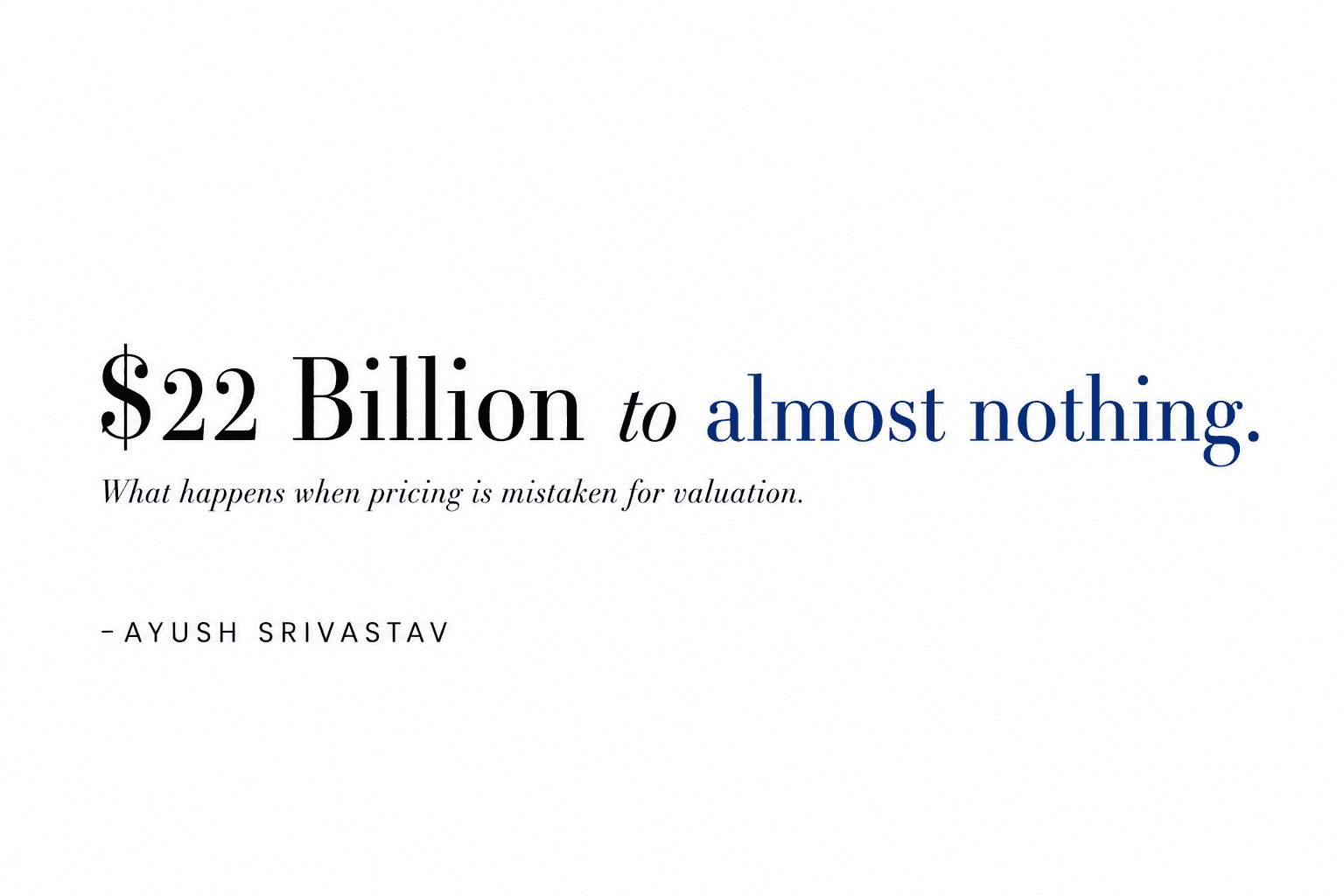
$22 billion in 2022. $1 billion by 2024. My DCF said ₹7,285 crore.
Cover image placeholder
The Story :
In 2022, Byju's was India's most valuable startup.
$22 billion. Lionel Messi as brand ambassador. Title sponsor of the Indian cricket team. Official sponsor of the FIFA World Cup. Over 100 investors including BlackRock, General Atlantic, Tencent, and the Chan Zuckerberg Initiative.
And then in January 2024, BlackRock, the world's largest asset manager cut its valuation of Byju's by 95%. From $22 billion to $1 billion. Prosus wrote off its entire $536 million investment. Baron Capital valued its stake at $120 million a 99.85% markdown. The founder himself stood up and said: it's worth zero.
Two years. $22 billion to zero.
How does something like this happen?
The honest answer is this: Byju's was never valued. It was priced.
Pricing is what someone is willing to pay today. It's driven by narrative, momentum and the story of what a company could become. In 2022 that narrative was irresistible: 150 million registered students, pandemic-driven online learning, global expansion across 40 countries, acquisitions building an education empire.
Valuation is what a business will actually generate in cash over its lifetime. It doesn't care about the narrative unless the narrative is backed by real numbers..
When I built the DCF using Byju's own reported FY2022 numbers. ₹5,015 crore revenue, negative 156% EBIT margin, ₹8,245 crore net loss - the number I arrived at was ₹7,285 crore equity value. Not $22 billion. Not even close.
Revenue Projection :
Byju's had four revenue streams and each told a different story.
The K-12 learning app was the foundation, roughly 55% of revenue in 2022. Built on users multiplied by ARPU: 7 million paying users at ₹400 per user in the base year, growing to 20 million users at ₹600 ARPU by terminal year 2032. Valuable but limited in how fast ARPU can grow when you're selling to middle-class Indian families with real budget constraints.
Test preparation through Aakash was stable and predictable. But it scales like infrastructure, not technology. More centres, more teachers, more physical presence. Not a high-multiple business regardless of what the market wanted to price it at.
International- through Epic and WhiteHat Jr was the narrative driver. The story of a global education empire. But international was bleeding cash, facing fierce competition, and generating revenue that grew far slower than the acquisition prices justified.
Upskilling through Great Learning was actually the most interesting channel: high ticket, outcome-linked, genuinely scalable. At only 5% of 2022 revenue it couldn't move the overall needle in the near term. But in my model, it became the growth driver i.e. learners growing from 25,000 to 250,000, fee per learner doubling from ₹1 lakh to ₹2 lakh, reaching 21% of total revenue by terminal year.
Even with generous assumptions : ₹24,000 crore total revenue by 2032, EBIT margins expanding from negative 156% to positive 22%, the business simply could not produce enough cash flow to justify anywhere near $22 billion in 2022. The investors weren't wrong about the market. EdTech in India is real. The problem was they were pricing the best possible version of the story, not valuing the actual business underneath it.
Then came February 2022. Russia invaded Ukraine. Global VC markets froze overnight. Byju's had been burning cash at an extraordinary rate spending ₹13,668 crore in FY2022 against ₹5,298 crore in revenue. The plan was to raise more capital continuously while the narrative stayed strong. When the capital markets closed, the plan collapsed. In June 2023 Deloitte resigned as auditor. Revenue had been booked incorrectly multi-year course fees recognised entirely upfront rather than spread over the course period. The narrative collapsed. Without the narrative, there was nothing left because nobody had asked the valuation question.
What this Means for You :
"I want to be careful about how I say this because it's easy to read the Byju's story and feel like the lesson is "don't raise at high valuations." That's not what I'm saying."
You can raise at any pricing you can negotiate. That is your right as a founder and sometimes the highest price is the right strategic decision - it buys runway, signals credibility, attracts talent.
But here's the thing I want you to sit with: Byju Raveendran didn't build a fraud. He built a real business with real students and real product. What he didn't have and what nobody around him seemed to ask for was an honest answer to the question underneath the narrative. If we strip away the story, what is this business actually worth?
That question is inconvenient when the market is generous. It becomes unavoidable when it isn't.
Knowing your intrinsic number doesn't stop you from raising at a higher price. It gives you a floor you understand. It tells you how much of the gap between your intrinsic value and your pricing round you need to close through execution before the next raise. It tells you what the market is giving you credit for in advance and what you need to deliver on to deserve it.
Most founders I speak with have never asked this question of their own business. They know their revenue. They don't know their intrinsic value. They don't know the gap between what they're worth and what they're raising at.
Byju's is the extreme version of this story. But the dynamic narrative driving price, price being mistaken for value happens in every boardroom, at every stage, every single day.
The number is yours to know. The pricing is a conversation you'll have with an investor. They are not the same thing. Knowing the difference is the most useful thing you can do before you walk into that room.

Image placeholder


"Byju's was never valued. It was priced. Understanding the difference might be the most important thing you do before your next investor conversation."
The question : if we strip away the story, what is this business actually worth is inconvenient when the market is generous. It becomes unavoidable when it isn't. You get to decide when you want to ask it.
Start a conversation → ayush@mulyan.co
Disclaimer:
Based on publicly available information including company filings and public disclosures as of FY2022. Independent analytical opinion for educational purposes only. Not investment advice. Byju's has not been consulted in the preparation of this analysis.