Valuation case study
Minimalist
HUL paid ₹2,955 crore for 90.5%. My DCF said it was worth ₹1,319 crore. This is about the gap
Cover image placeholder

The Setup :
Two brothers from Jaipur. 1,000 bottles. Zero marketing budget. October 2020.
Within 8 months: ₹100 crore revenue. Profitably.
In January 2025, Hindustan Unilever paid ₹2,955 crore for 90.5% of Minimalist - a sales multiple of 5.9x revenue, nearly double the 3-4x industry standard for profitable D2C beauty brands.
My DCF-derived intrinsic equity value: ₹1,319 crore. HUL's implied equity value: approximately ₹3,265 crore. The gap between those two numbers is ₹1,946 crore.
This page is about what that gap actually represents and why it matters for every founder building a consumer brand today.
Mohit and Rahul Yadav weren't first-time founders. They had built and sold companies before. By 2018 Mohit had co-founded Freewill a personalised haircare brand backed by Sequoia's Surge program giving them manufacturing relationships, regulatory knowledge and deep insight into the Indian beauty consumer. They had 12 years of experience when they launched Minimalist. That context matters enormously for the valuation. Experienced founders execute differently and de-risk faster than first-time founders. That difference shows up in the cost of capital.
The insight that created Minimalist came from a Canadian brand called The Ordinary, which proved that consumers globally would choose ingredient honesty over aspirational promises. Mohit asked one question: why hasn't this happened in India? The answer was nobody had tried it. So they did. One Instagram post to 200 followers. Sold out in two days. 10,000 followers by the end of that week. Product-market fit doesn't announce itself more clearly than that.
The Revenue Build :
I built the revenue model around four product categories not channels, because this is how the business actually grows and how consumer brand founders think about their own trajectory.
Serums : ₹156 crore in FY2024, 45% of revenue. Mohit publicly stated 20% market share in India's face serum category, which was approximately ₹1,000 crore in 2024. A bottom-up model that validates the founder's own stated market position is rare and meaningful. The serum TAM grows to ₹3,500 crore by 2036 as active skincare penetrates Tier 2 and 3 cities. Minimalist maintains 20% share through first-mover advantage and 40+ serum variants. Serum revenue reaches ₹700 crore by 2036.
Core Skincare - sunscreen, moisturisers, toners : ₹104 crore in FY2024, 30% of revenue. This becomes the largest category by 2036 at ₹750 crore. India's SPF awareness is at the beginning of a decade-long adoption curve. Dermatologists, social media and urban pollution are secular trends that compound for years. HUL's distribution will accelerate this, sunscreen benefits more from offline reach than any other Minimalist category.
Body and Hair Care : ₹87 crore in FY2024, 25% of revenue. Grows to ₹450 crore by 2036. The logical brand extension as Minimalist's core skincare customer expands their routine. Lower growth rate than core categories because differentiation is less sharp here.
Advanced Skincare - Anti-Ageing : zero today, ₹219 crore by terminal year. Anti-ageing is a multi-billion dollar category in the US and Europe. In India it barely exists not because Indians don't age, but because consumer awareness and purchasing power hadn't reached critical mass yet. By 2031 this changes. Minimalist with its science credibility and HUL's global R&D is positioned to lead this category the same way they led serums.
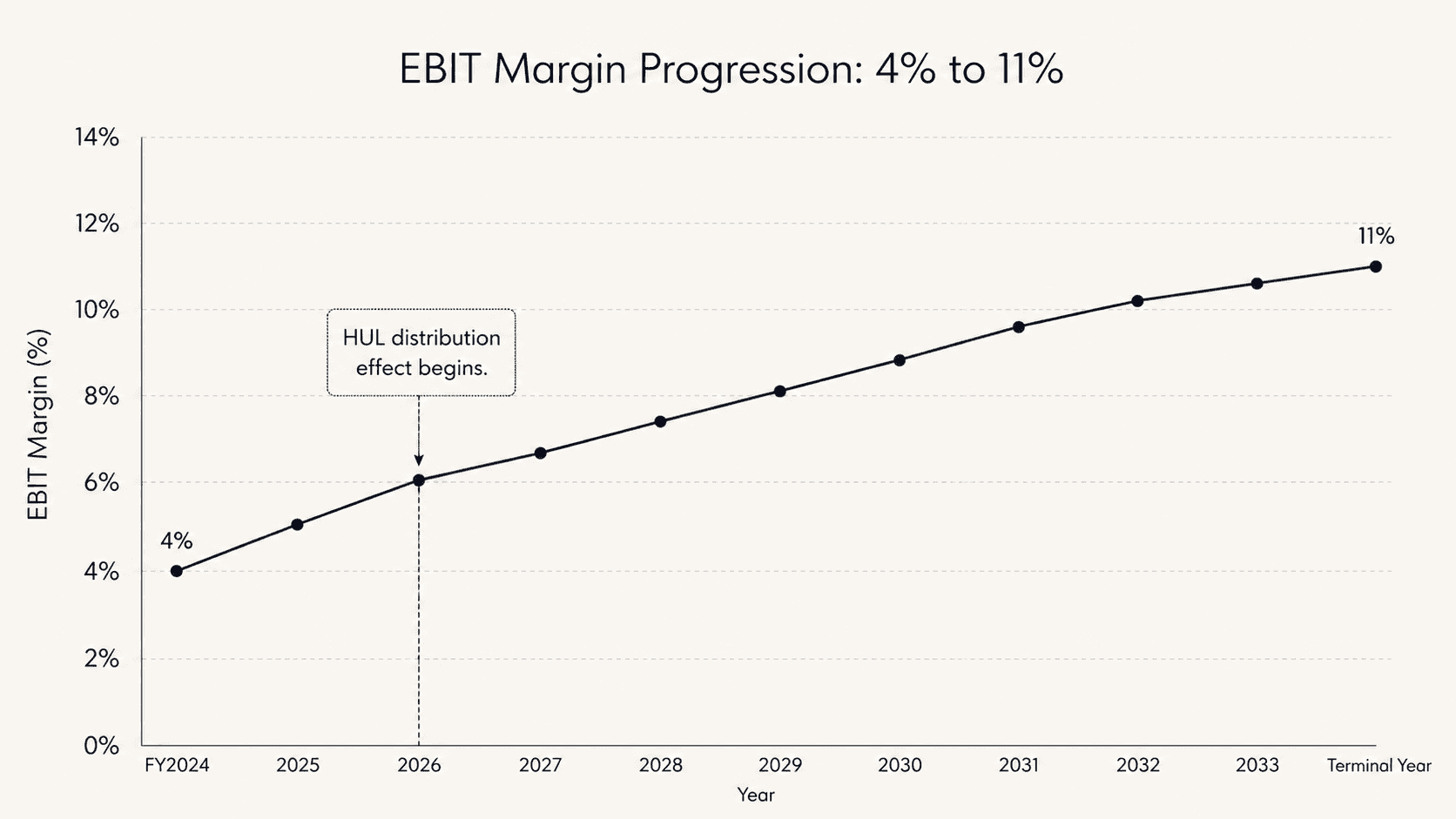
Total projected revenue: approximately ₹2,300 crore by terminal year. The 2026 step change in the model reflects HUL's 20,000-store distribution beginning to deliver across all categories simultaneously.
One retention number anchors everything: 60%. Mohit mentioned this in a podcast. Most D2C brands celebrate 30-40% retention. 60% means more than half of every customer acquired keeps coming back. That's the compounding engine underneath all the revenue projections and the number that makes the intrinsic value defensible.
Margins start at 4% EBIT in FY2024 - low for a brand of this quality but deliberate. Minimalist accepted lower gross margins because they refused to compromise product quality. The trajectory changes fundamentally with HUL: distribution reduces CAC, 20,000 stores create organic discovery, and operating leverage compounds. Terminal EBIT margin: 11%, consistent with Estée Lauder's operating margin profile for their beauty divisions.
Cost of capital starts at approximately 14-15% at base year reflecting four profitable years, ₹500 crore ARR, zero financial distress risk and a strategic buyer already in the relationship. This steps down to approximately 9-10% by terminal year as HUL subsidiary status brings FMCG sector cost of capital.
What the Gap Means :
My intrinsic equity value: ₹1,319 crore. HUL's implied equity value: ₹3,265 crore. The gap: ₹1,946 crore, a 148% premium above intrinsic cash flow value.
This gap is not irrational. It is precisely what strategic acquisitions look like when a large corporation buys something it cannot build organically.
HUL bought a consumer cohort worth ₹500+ crore to acquire from scratch. They bought the digital distribution capability they didn't have. They bought a defensive moat against global ingredient-led brands entering India. They bought time they couldn't afford to spend. And I believe they bought Mohit and Rahul.
The verdict: HUL overpaid on a DCF basis. They underpaid on a strategic basis. The difference is ₹1,946 crore and it was worth every rupee.
What every D2C founder should take from this: your business has two values. One is what the cash flows say it's worth — the intrinsic value, built from revenue, margins, reinvestment, and risk. The other is what a strategic buyer will pay for what you've built that they can't build themselves. Understanding both numbers, and the gap between them, is the most powerful negotiating position any founder can have.
Most founders know their revenue. They don't know their intrinsic value, their strategic value, or the gap between the two. That gap is where founder wealth is created or destroyed.

"HUL overpaid on a DCF basis. They underpaid on a strategic basis. The difference is ₹1,946 crore and it was worth every rupee."
Your retention rate is your valuation multiple. Not your Instagram followers. Not your GMV. 60% retention is the number that made ₹1,319 crore of intrinsic value possible for Minimalist. The same methodology applies to your business. Different numbers, same framework.
Start a conversation → ayush@mulyan.co
Disclaimer:
Based on publicly available data including company filings, founder statements, and public disclosures as of FY2024. Independent analytical opinion only, not investment advice. Minimalist and HUL have not been consulted in the preparation of this analysis.